

2024.Q4 PERFORMANCE
4th Quarter Recap - AI Drives Superior Returns
As of December 19, 2024
The stock market has provided client portfolios with experiencing returns well above the benchmark. As of this writing of the Client Letter, the SP500 was up 24.8% and the Bloomberg Bond Index inched ahead by 1.4% while most portfolios have exceeded these benchmarks.
Equity holdings that are leading performance either provide AI (Artificial Intelligence) products and services or provide energy to the AI industry providers. Nvidia has been the largest gainers so far in 2024, while GE Vernova and Constellation Energy were also big winners. A long-time favorite of AHIA, Garmin continued to surprise analysts with strong earnings that led to a 62.9% rise in the stock price so far in 2024. Other notable winners included Arista Networks, Oneok, American Superconductor and many others.
SP500 Trending Higher
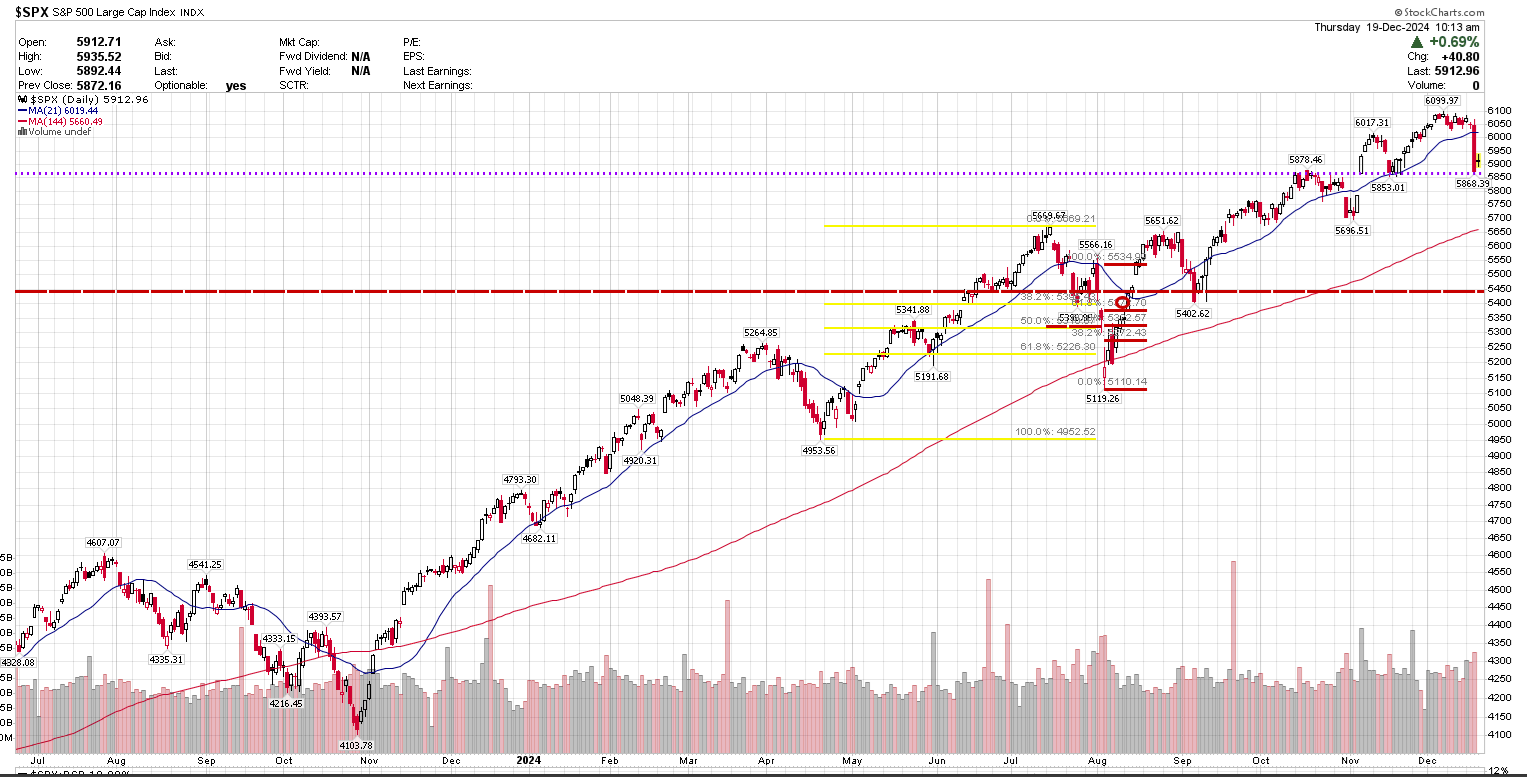
While we did experience a few losers, we attempt to keep our losses limited and strive to exit positions quickly when our thesis is not panning out. Our largest losers were Adobe, Idexx, and Enphase.
In fixed income, most client portfolios achieved total returns just above the 2% return of the Bloomberg bond index. Since interest rates have modestly risen in 2024, it lowered the value of bonds, and interest income was a primary source of income. Since fixed income portfolios are the defensive part of the portfolio, we are pleased that most client portfolios have a strong average Standard & Poor’s credit rating of A or higher.
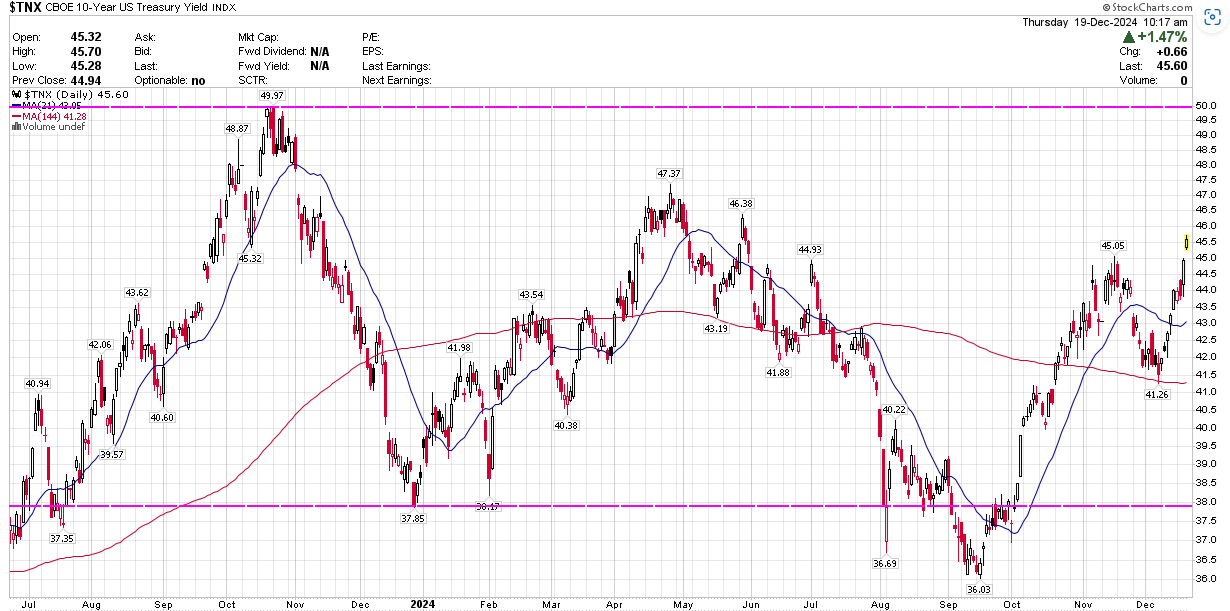
10 Year Treasury Bond Yield Trending Higher – Not Good
The Economy Is Growing And Inflation Is A Concern
Heading into the end of 2024, the economy is strong and led by consumer spending and technology investment. 4th quarter GDP (Gross Domestic Product, the widest measure of the U.S. Economy) is estimated to grow 3.3% according to the Federal Reserve Bank of Atlanta’s GDP now index. Inflation has moderated in 2024, but further declines may be unlikely as labor costs are unlikely to fall while product costs may increase next year. On the positive side, oil appears to be stable near $70 a barrel per West Texas Intermediate. Global demand is moderating while supply is widespread. Interestingly, China has seen decreasing demand for oil, possibly due to 50% of Chinese auto sales being Electric or Hybrid vehicles.
The Federal Reserve has lowered the Federal Funds Rate, its short-term interest rate, to 4.5% from 5.5% over the past quarter. Strong economic growth, moderating inflation and Federal Reserve interest rate cuts have been a positive backdrop for the financial markets. Looking forward, several factors will change.
Lower short-term interest rates are having mixed reactions in the bond market. Since the Federal Reserve began cutting interest rates short-term yields have fallen, but longer-term interest rates have increased. The 10-year Treasury bond yield has increased from September lows of 3.6% to 4.5% and rising. This is not good for mortgage rates or long-term financing of large capital investment.
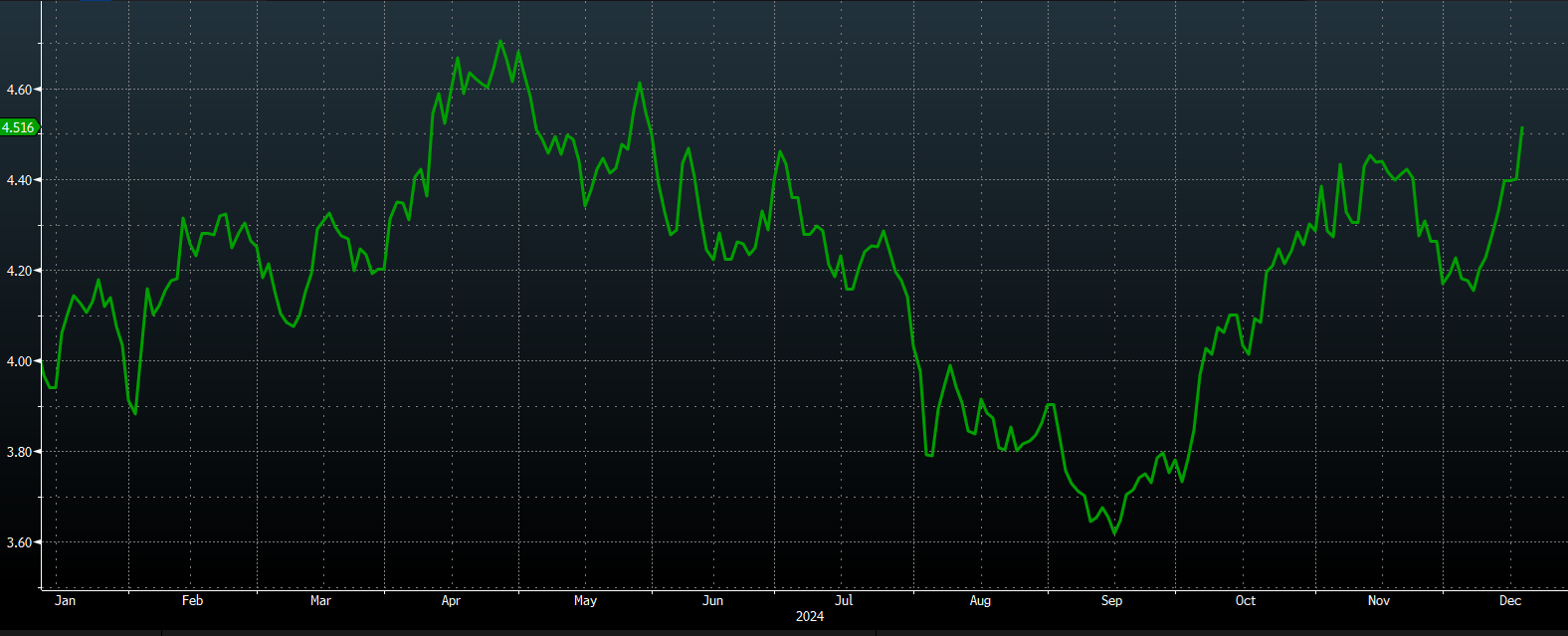
However, short-term yields have fallen, which is good for someone with an adjustable mortgage. Conversely, with nearly $7 trillion in money market funds, what will be the impact of yields possibly dropping below 4% on consumer spending? Many wealthy individuals are living off high yielding money market accounts that are quickly not yielding so much. Add in inflation and these accounts are closer to break even returns.
With the change in the White House coming in January, what policies the Trump administration enact in the short-term and over time? The major questions to focus on:
- Tariffs
- Continuation of Bidens’ IRA, CHIP Act & infrastructure bills
- Regulation changes
- Tax changes and implications for budget deficit
- Immigration & Deportation
Political specialists expect the new administration will enact these policies as soon as possible, so that any economic pain may be felt, processed, and dealt with quickly. Tariffs from 10% to 60% have been rumored.
Historically, tariffs have generally led to a bad economy. 2018 tariffs on solar panels increased the cost 200% over Asian suppliers, bankrupting some solar installers and killing the home solar market. This eliminated the middle-income homeowner who wanted to install solar panels on their home to save on electricity and protect against power outages.

Immigration and deportations are a key risk. If President Trump carries through on past comments, there will be massive deportations. This would negatively effect the labor market and raise inflation. Immigrants have made up a large portion of the jobs created in 2024, as the domestic increase in the work force is essentially 0%. The job gains have largely come from the Education & Health and Leisure & Hospitality industries.
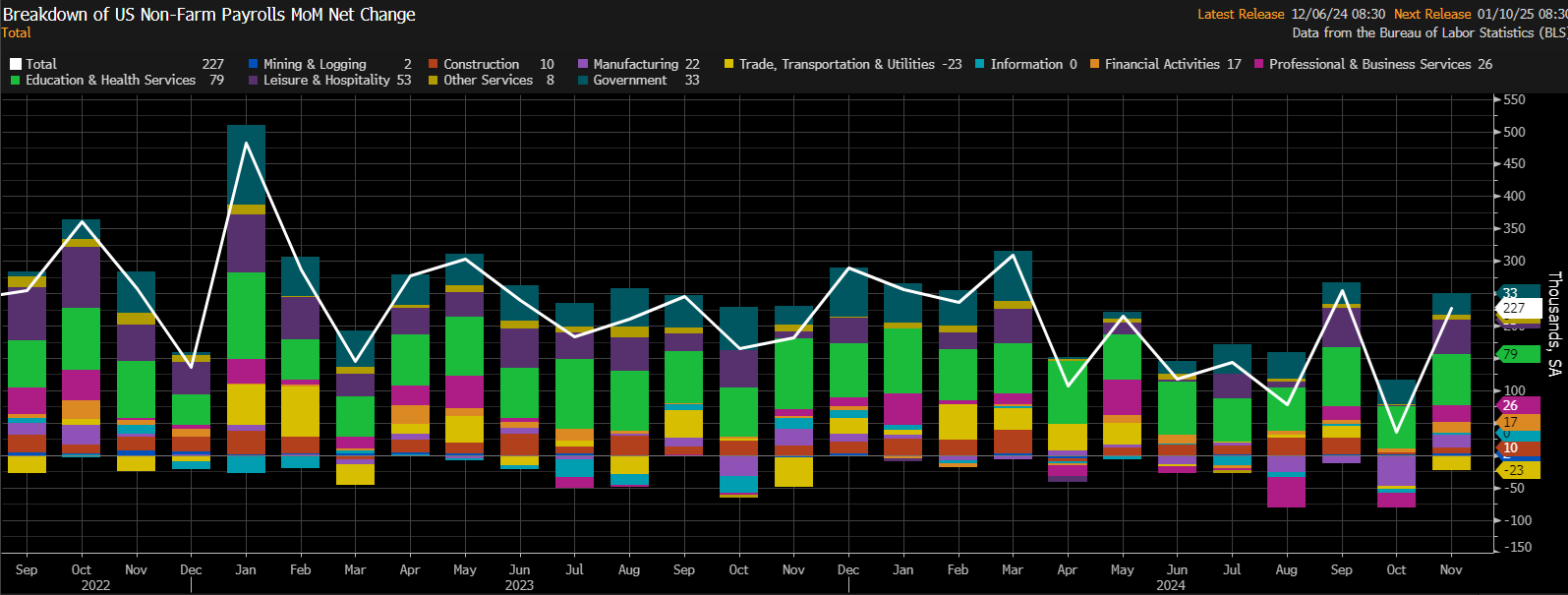
Summing up our economic outlook, GDP has positive momentum leading into 2025. The Trump administration will be a mix of potentially positive and negative factors impacting the current positive economic trends. There will be shocks in some parts of the market, the focus will be on the response and ability of companies to navigate these choppy waters.
Portfolio Strategy Update
Looking at 2025, our best case is for equity returns of 5% to 10% with wide swings in individual companies and sectors, just as we are currently experiencing after the Federal Reserve meeting this week. In the bond market, we expect longer-term yields to inch higher with the 10-Year Treasury yield possibly reaching 5% in 2025 and short-term interest rates remaining close to current levels with the 1-Year Treasury yield averaging around 4.3%.
2024 has been a very strong year for stock performance while bonds chipped in a little interest income. Due to massive appreciation over the past two years, stock allocations are now above most clients’ investment policy targets. Thus, we have started to reduce equity exposure moderately in some IRA and pension accounts. In the past few weeks, the equity allocation across all portfolios has decreased by about 5%. With taxes in mind, we had hoped to forgo selling stocks with gains until January, but the trends have turned negative recently. Our favorite technical indicator, the Put/Call Ratio, has been a “sell” signal recently.

The bond market may hold the key to equity market returns. We don’t want the economy to be too cold or inflation too hot. Using the 10-Year Treasury bond as the interest rate proxy, we believe if interest rates hold between 3.8% to 4.9%, stocks will be “ok”. Yields above 5% suggest either inflation is heating up or investors have grown concerned about the deficit. Yields below 3.8% suggest the economy has entered a recession or is experiencing some sort of economic downturn, thus hurting corporate earnings. Since bond yields influence stocks indirectly, staying within this range increases the likelihood stocks produce their average returns of about 10%. Returns above require interest rates to remain stable, benefits from deregulation, and minimal impact from inflationary policies such as tariffs and immigration.
Fixed Income Strategy
As we have recently harvested profits in equities, those funds have been added to clients’ bond ladders (bond maturities targeting annual withdrawals). Our long-term portfolio strategy has been to hold funds needed in the next five to seven years in high quality bonds, which is our current strategy, and we plan to expand with funds from the equity market holdings. This strategy reduces portfolio risk in the short to intermediate term, while allowing equities to assume the long-term capital appreciation position.
In the bond market, we expect that short-term interest rates will be lower as the Federal Reserve reduces the Federal funds rate, while long-term interest rates may trend higher. As covered in the recent Federal Reserve meeting and subsequent press conference, future cuts in short-term interest rates, if any, will be contingent upon inflation trending towards their 2% objective. With the incoming Trump administration’s anticipated policies being highly inflationary, estimates for inflation among the Federal Board members are creeping higher although it is uncertain exactly what will happen.
Our strategy is to ladder bond maturities, meaning spreading maturities out evenly over a multi-year period. For IRA’s and tax deferred accounts we prefer high grade corporate bonds, some of which have floating interest rates. For taxable accounts, municipal bonds with maturities over seven years are the best return net of tax-free interest income.
Equity Strategy
Equity prices, in general, follow trends with interest rates, corporate earnings, and sentiment. With the risk of higher interest rates due partly to economic strength, corporate earnings could increase by 10% to 14%, which is pretty good. Sentiment is often quantified by the Price to Earnings ratio (P/E ratio), or how much investors are willing to pay for future earnings. Presently, the P/E ratio of the SP500 is 22 times 2025 earnings, which is a bit rich. With the Trump administration set to enact new policies beginning January, we keep our sight focused on the opportunities and challenges to come. Apple, the largest holding in the SP500, will be reflective of the much talked about tariff policies. Most of Apple’s manufacturing is in Asia, thus would be subject to significant tariffs. What would the impact be on an iPhone currently selling for $999? Again, if policies increase inflation, we are at risk of higher interest rates that could lead to lower equity prices.
Sector allocations with the equity market offer interesting opportunities and challenges. The growth in the technology sector and its closely related cohorts has greatly benefited the utility industry, which has created millions in profits over the past few years for AHIA clients. Technology companies have created all kinds of services to make our life better. However, all these new things require more electricity than ever before, hence the big jump in utility stocks in early 2024.
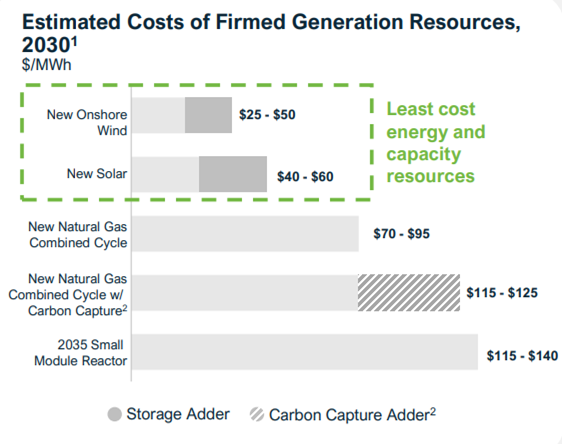
Recently, investors have started to question if the Inflation Reduction Act (IRA) will remain under the Trump administration. The IRA provides tax incentives to produce carbon free electricity. The nuclear power industry has been a huge beneficiary as the tax incentives made nuclear power profitable. Like nuclear power, solar and wind power also receive tax incentives under the IRA. As the chart below presents, solar and wind are the cheapest forms of power. Further, solar is the quickest to construct. However, just like a portfolio, you need more than one position. A combination of renewable battery storage and natural gas or nuclear is the best mix of cost, reliability, and environmentally friendliness. We have trimmed back our core tech and utility holdings recently as investors have either realized above market profits or are concerned that the IRA will be either revoked or significantly diluted.
NextEra Energy’s Estimated costs of producing electricity in the Future
Source: NextEra Energy Investor presentation November 2024
Our weighting of the financial sector has increased recently in anticipation of appropriate business regulation. We have significantly increased the position of Goldman Sachs, the leading investment banker in the world. We continue to hold JP Morgan, the leading bank that covers many financial sectors. A less restrictive regulatory environment would reduce costs and allow traditional banks to compete with non-regulated lenders such as private lenders. Specialty insurance is a new area of interest with a holding in Skyward Specialty Insurance. The company provides property and casualty insurance for unique and unusual risks. We may add exposure to other emerging financial companies. We hope the correct regulatory balance needed for safety of the financial sector is achieved, especially with the integration of crypto currencies that have had little regulation to date that can lead to billions in losses from fraud and failure of crypto exchanges, like FTX in 2022.
One sector that has been hard hit lately and underperformed relative to SP500 is the healthcare sector. Lately, the healthcare insurers have been destroyed, although we have not held exposure in this segment since selling United Healthcare several years ago, when we questioned their coverage denial of medical claims. Our interest is focused on drug and device providers that are developing new solutions to make society better. Recently, we added a small position in Johnson & Johnson that has a dividend yield of 3% and a solid pipeline of new products. Also, we have increased exposure to United Therapeutics, a small company developing artificial organs while their approved hypertension drugs fund research and development.
AHIA Top 10 Holdings
Apple (AAPL)
Apple is the global leader in consumer electronics, known for their iPhones, iPads, Mac computers and other services. They’re constantly innovating, and next up is “Apple Intelligence” – AI features designed to make their devices even smarter, improving productivity, connectivity, and entertainment. We invest in Apple due to its ability to maintain market leadership through innovation and its ability to protect their “ecosystem” of Apple products and services.
Garmin (GRMN)
Garmin is a market leader in GPS devices and navigation systems. They are also bringing these products to multiple markets, including fitness & outdoor (watches), automotive, marine, and even aviation. The company’s products are highly reliable and promote health and fitness, benefiting its users and society. As the company enhances its technology it will continue to reach more markets. If you need advice on a Garmin device for your boat, reach out to Andy – he’d be happy to discuss.
Constellation Energy (CEG)
Constellation Energy is the largest producer of nuclear energy in the U.S., controlling about 30% of the country’s total capacity. While they’re also involved in wind and gas, nuclear power is their core business. Recently, they made headlines with the Three Mile Island deal, providing clean energy to Microsoft which has high demand for reliable power. With nuclear capacity expected to grow 4% and demand skyrocketing, Constellation is positioned to see solid profitability in the coming decade.
NVIDIA (NVDA)
Nvidia has been the stock to watch this year, and it’s easy to see why. The company leads the semiconductor industry, providing the “brains” behind AI. Have you ever used ChatGPT? It’s powered by Nvidia’s chips. Nvidia is miles ahead of its competition and plans to release a new chip model every year, each far superior to the last. Beyond AI, their chips are also key in self-driving cars, gaming, and computing. Plus, Nvidia’s technology is being used in groundbreaking areas like drug research, helping accelerate medical advancements for the betterment of society. With their products serving quickly growing markets, Nvidia is well positioned for the long term.
Microsoft (MSFT)
Microsoft is at the forefront of AI, integrating it across all its business lines. One standout is their “Co-Pilot” subscription, an AI tool that enhances productivity within Microsoft Word, PowerPoint, and more. Their Azure cloud platform is among the best in enterprise computing and continues to drive significant growth. Beyond business, Microsoft is leading the way in sustainability, as they’ve already achieved carbon-negative status and aim to remove their entire carbon footprint by 2050, making a powerful impact on the planet. With innovation and leadership in AI, Microsoft is well-positioned to shape the future of both technology and environmental responsibility.
Goldman Sachs (GS)
Goldman Sachs is the premier investment bank in the U.S., offering services in mergers and acquisitions (M&A) advisory, underwriting, and trading. The company’s strong reputation makes it the go-to choice for high-stakes deals. With the new administration and an expected uptick in M&A activity, Goldman is well positioned to leverage its extensive network and expertise to lead even more deals. Beyond business growth, Goldman plays a key role in facilitating market efficiency and economic development through its advisory services, helping companies and economies thrive.
GE Vernova (GEV)
GE Vernova is the largest global energy supplier, generating about 30% of the world’s electricity. With a diverse portfolio that includes gas, wind, nuclear, and hydro, the company has unmatched market reach. Recently, GE Vernova has streamlined its operations to become more efficient and profitable, earning market praise and driving its stock upward. As the world moves toward clean energy, GE Vernova’s significant market share and diverse energy generation capabilities make it a key player in powering the transition to a greener future.
JPMorgan Chase & Co. (JPM)
JPMorgan is the largest bank in America, with five major business units, each large enough to operate as its own company. From traditional lending to wealth management and investment banking, the company’s scale and diverse operations give it a unique edge in the financial industry. JPMorgan’s efficiency and deep integration into the U.S. financial system make it a key player in shaping the market. With such a broad client base, JPMorgan can leverage its reach and expertise to maintain a competitive advantage across every sector it serves.
Arista Networks (ANET)
Arista Networks is a key player in the infrastructure behind AI and data centers. The company provides high-performance cables and switches that are crucial for the operation of data centers, a growing business driven by the rise of AI. As the need for AI expands, so does the demand for Arista’s products. Their Ethernet cables not only improve energy efficiency in data centers but also help lower lifetime operational costs. Arista’s solutions make them an essential part of the AI infrastructure, with a product offering that enhances both performance and cost-effectiveness.
Amazon (AMZN)
Amazon is a two-headed giant, leading the world in both E-commerce and cloud computing with its dominant online retail platform and Amazon Web Services (AWS). Their retail success is backed by a highly efficient logistics network, enabling them to offer fast delivery and a broad selection of products to customers globally. AWS, the backbone of their cloud services, is a market leader, providing essential infrastructure for businesses across industries. Amazon is also leveraging AI to enhance product recommendations, optimize advertising, and improve operational efficiency. With its unmatched scale in both E-commerce and cloud computing, Amazon is well-positioned for sustained growth, continuing to capture new customers and expand its market leadership.
Buffalo Based Sean O’Brien Makes Visit to Local High School

Over the past two months, our Associate Portfolio Manager, Sean O’Brien, has actively engaged with the Buffalo, NY community by visiting a local high school. During his first visit, Sean joined professors and students from Canisius University to showcase their business programs. Representing the Finance department, Sean shared insights into what a degree and career in Finance can offer students.
Following this visit Sean was invited back to speak with the school’s “Stock Market Club,” a group of students managing simulated portfolios. Sean gave a presentation highlighting what criteria he looks for in a company and how to identify good buy or sell signals. This interactive session sparked lively discussions about the traits of successful investors, specific stocks of interest, and the research tools Sean prefers. The school has since invited Sean back for another presentation in early 2025. Go Bills!!!
Year-End Tax and Financial Planning items to Consider

- IRA owners who are eligible to contribute have until April 15, 2025, to max out for tax year 2024
- 401(k) participants have until December 31, 2024, to fund their account with pre-tax earnings to report for tax year 2023.
- It is legal to have multiple 401(k) accounts; however, the deferral limit (2024: $23,000 and an additional $7,500 for age 50 and older) applies equally to all 401(k) accounts. In addition, not all 401(k) plans have an employer matching component, so it is best to max out on the 401(k) with an employer match to take advantage of the free money.
- Health Savings Accounts for eligible individuals provide tax-deductible contributions, grow tax free and withdrawals for qualified medical expenses are tax-free. Due to the rising cost of long-term care and medical expenses, these accounts are becoming very popular, especially for younger investors. For 2024, the contribution limit for self-only coverage is $4,150 and for a family plan is $8,300, plus an additional $1,000 for those age 55 and older. You can contribute to this year’s Health Savings Account through April 15, 2025.
- During the last week of 2024, we will be reaching out to clients and/or their tax consultants with the year-end gain and loss reports for 4th quarter estimates and 2025 tax planning.
- Making charitable contributions with appreciated securities, or to a Donor Advised Fund (DAF), are great ways to reduce your potential capital gains taxes and support your favorite charities. DAF’s are 501©(3) exempt organizations. If you contribute cash, securities or other assets to a DAF, you can generally take a charitable deduction in the year of the transfer. The assets in DAF grow tax free and you advise the DAF to make grants from your account to specific charities. If you are interested in supporting a charity, please contact us quickly as there may be issues to consider.
- If you are age 59 1/2 or older and participate in a 401(k) plan, you can consider rolling over your balance to your IRA without affecting future contributions and employer contributions.
- Review the beneficiaries of all your accounts (IRA, bank accounts, investment accounts) and life insurance policies.
As always, our comments are general in nature. Please call Jennifer or Andy to discuss any of these issues and others to evaluate your overall tax and legal circumstances.
Importance of Client Cyber Security

The FBI and the Cybersecurity and Infrastructure Security Agency are warning Americans to stop using text and call services that do not feature end-to-end encryption. Encryption keeps unwanted eyes from being able to see and read what you are texting. If you are texting from one iPhone to another iPhone, or from one Android to another Android, it is still secure. However, the problem arises when one user has an iPhone and the other user has an Android, or if there is a group chat with both users.
Until the industry can sort this problem out, we are urging all clients to avoid sending messages to our staff via text that include bank account numbers, credit card details, passwords, screen shots of financial statements, medical records, passport and drivers licenses/photo identification. We recommend you do the same among your contacts until you are confident that both parties are using the same platform, or you switch to a fully encrypted messaging platform. Encrypting options include WhatsApp, which is a popular secure messaging app that works with an existing phone number. Facebook users can use the Messenger app which provides end-to-end encryption for both one-on-one and group messaging.
Considering the FBI’s warnings, we recommend when communicating requests or sending us money movement information, that you either email us or even better call us. Text messages are ok for nonessential communications like where we are meeting on chirping about your favorite sports team.
For more information, please visit the following link: FBI Warns iPhone And Android Users—Stop Sending Texts
Disclosures
Andrew Hill Investment Advisors, Inc. is registered as an investment adviser with the Securities and Exchange Commission (SEC), and only transacts business in states where it is properly notice filed, or is excluded or exempted from such requirements. SEC registration does not constitute an endorsement of the firm by the Commission nor does it indicate that the adviser has attained a particular level of skill or ability. Sources of our Client Letter include Bloomberg, Wall Street Journal, Barron’s, corporate disclosures of the companies mentioned in this document, and internal research.
OUR TEAM

Andrew “Andy”
D. W. Hill, CFA
President and
Co-Founder

Jennifer R.
Figurelli, CTFA
Managing Director
and Co-Founder

Elicha D.
Moore
Client Concierge
Representative

Sean
O'Brien
Associate
Portfolio Manager
